

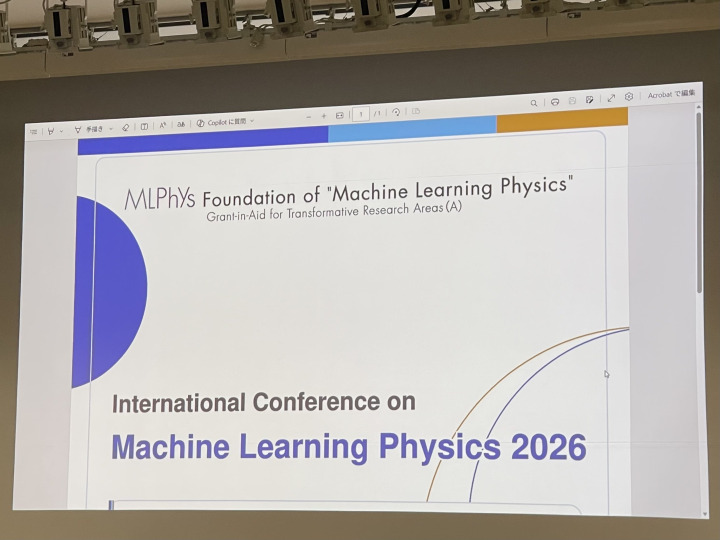
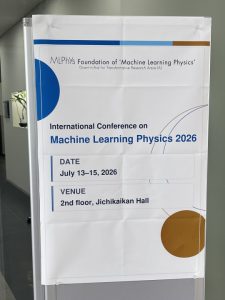
MLPhys 2026 – International Conference on Machine Learning Physics 2026 was held from July 13 to 15, 2026, at Jichikaikan Hall on the second floor in Naha, Okinawa, Japan.
MLPhys is an international conference that brings together researchers working in physics, machine learning, and related interdisciplinary fields. The conference aims to promote the integration of physics and machine learning from two complementary perspectives: applying machine-learning techniques to advance the understanding of physical phenomena and using physical concepts and mathematical structures to develop new machine-learning methods. Researchers from different backgrounds gathered to present recent results and discuss emerging directions in machine learning physics.
We presented the following poster:
Session Information
Session Type: Poster Presentation
Presentation Date: Monday, July 13, 2026
- Phonepaserth Sisaykeo and Shogo Muramatsu, “Koopman–Chebyshev Spectrum Linking for Data-Driven PDE Identification,” MLPhys 2026 – International Conference on Machine Learning Physics 2026, Okinawa, Japan, 2026.

Our poster presented a data-driven framework for identifying governing partial differential equations by linking observation-driven and equation-driven Koopman operators through a common Chebyshev spectral representation. During the poster session, we explained the fundamental concept of the Koopman–Chebyshev spectrum-linking framework and discussed its potential applications to the identification and analysis of unknown dynamical systems from observational data.
The conference offered a valuable opportunity to attend invited talks and poster presentations covering a wide range of topics at the intersection of machine learning and physics. These presentations provided useful insights into recent developments in physics-informed machine learning, scientific discovery, inverse problems, quantum many-body systems, neural-network theory, and data-driven physical modeling.
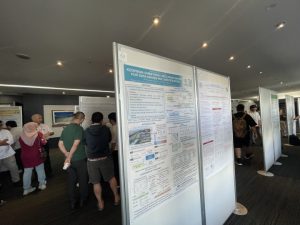
Our poster presentation also led to meaningful discussions with researchers from different academic backgrounds. Their questions, comments, and suggestions helped us consider the proposed framework from new perspectives and identify possible directions for further investigation. In particular, the discussions were valuable for improving how we explain the relationship between observational data, spectral representations, Koopman operators, and governing PDE identification.
We sincerely appreciate everyone who visited our poster and shared valuable comments and ideas with us. Participation in MLPhys 2026 was an excellent opportunity to present our research, learn about emerging interdisciplinary research, and develop new connections with researchers working in machine learning, computational physics, and related fields. We look forward to applying the knowledge and feedback gained from this conference to our future research activities.